
-
-
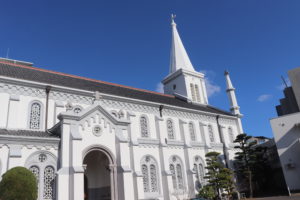
Nakamachi Church was constructed in 1986
2024/01/04
History of Japanese ChristianityNakamachi Church is located near JR Nagasaki Station which was constructed for Japanese Christians in 1986. The church was dedicated to the 16 Saints of Nagasaki (St. Thomas and the 15 Martyrs) in 1988, and the monument honoring them was erected in the premise. The 16 Saints were martyred in Nagasaki from 1633 to 1637. The 16 martyrs became Saints in 1987, since 26 Saint. Dominic Ibáñez de Erquicia Pérez de Lete, Spanish, 1633, Dominican Priest Antonio Gonzalez, Spanish, 1637, Dominican Priest Jordan Ansalone, Italian, 1634, Dominican Priest Luke of the Holy Spirit Alonso Gorda, Spanish, 1633, Dominican Priest Michael de Aozaraza, Spanish, 1637, Dominican Priest Guillaume Courtet, French, 1637, Dominican Priest Jacobo Kyushei Gorōbyōe Tomonaga de Santa María, Japanese, 1633, Dominican Priest Thomas Rokuzayemon Nishi, Japanese, 1634, Dominican Priest Vincent Shiwozuka, Japanese, 1637, Dominican Priest Francis Shōyemon, Japanese, 1633 Matthew Kohioye, Japanese, 1633 Lorenzo Ruiz, Filipino, 1637 Marina of Omura, Japanese, 1634 Magdalene of Nagasaki, Japanese, 1634 Michael Kurobioye, Japanese, 1633 Lazarus of Kyoto, Japanese, 1637
-

-
Wakato bridge in Kitakyushu-city, constructed in 1962
2024/01/13
Japanese historyWakato bridge is Japan’s first suspension bridge over the Dokai Bay, connecting Wakamatsu and Tobata, and was completed in 1962. At the time of its completion, it was the largest suspension bridge in the East, and due to problems with welding reliability, it was constructed using riveted joints. 24,000 tons of steel used manufactured at Yawata Steel Works.
-

-
Catholic Unzen Church, built in 1982
2024/01/05
History of Japanese ChristianityThe Church is dedicated to Antonio Ishida and others who were martyred in the Unzen jigoku from 1627 to 1632 and was built in 1982 to commemorate Pope John Paul II’s visit to Nagasaki. The number of believers in the church is small, but many pilgrims visit, since it is also a place of martyrdom.
-

-
St. Andrew’s Seminary at Dejima, opened in 1877
2024/01/09
History of Japanese ChristianityAfter the ban on Christianity lifted in 1873, Burnside who was the British Church Missionary created a cram school at his home to teach the English Bible. In 1877, the school was moved to the Dejima English-Japanese School building at Dejima, and St. Andrew’s Seminary was opened. It was then used as the Seminary until 1886.
-

-
Mizutaki, in Fukuoka
2024/01/04
Japanese cuisineIt is a local cuisine in Fukuoka. Mizutaki (boil in water) describes, this is a hot pot dish made with chopped chickens, negi, and a variety of vegetables put in a pot of water and boiled, then dipped in ponzu sauce.
-
-
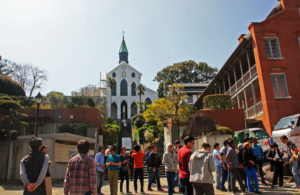
Oura Cathedral, built in 1865
2024/01/14
History of Japanese ChristianityThe Cathdral was built in 1865 by the French priest Bernard Petitjean of Fier who had been dispatched by the Foreign Missionary Church of Paris to dedicate prayers to the 26 saints martyred on Nishizaka hill. For this reason, the church faces Nishizaka hill. It was designated as a National Treasure in 1933 for its value as Japan’s oldest Gothic-style Cathedral. For this reason, the church faces Nishizaka hill. It was designated as a National Treasure in 1933 for its value as Japan’s oldest Gothic-style Cathedral.
-
-
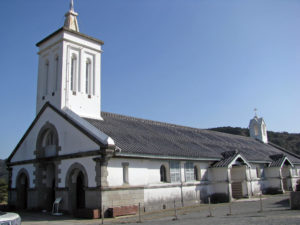
Shitsu Church, in Sotome, constructed in 1882
2024/01/09
History of Japanese ChristianityBuilt in 1882 by Father de Rotz, this low-ceiling church features a brick exterior, wood interior and stone entranceway. The roof itself is low in order to limit damage done by strong winds. The church’s bell was brought here from France by a priest and rings out beautifully every morning. The location is famous as the place where the movie “Gege” was filmed.
-
-
Urakami Cathedral, in Nagasaki, constructed in 1914
2024/01/06
History of Japanese ChristianityConstruction of the original Urakami Cathedral, a brick Romanesque building, began in 1895, after a long-standing ban on Christianity was lifted. When completed in 1914, it was the largest Catholic church in East Asia. The Atomic bomb dropped on August 9, 1945 explored in Urakami, only 500m from the cathedral, which was completely destroyed.
-
-
Kirishiama
2024/01/30
Onsen resortLocated on the lower slopes of the Kirishima Mountain with a distant view over Kagoshima Bay and Sakurajima below. The area is made up of over a dozen Onsen, of which the largest and best know is Maruo Onsen. With its high concentration of hotels and central location, Maruo Onsen is the representative resort town of the entire Kirishima Onsen area. The hot spring towns around Kirishima Onsen are dotted with Ryokan and hotels of various sizes
-
-
Amakusa Gokyo, built in 1966
2024/01/12
Japanese historyAmakusa Gokyo or Amakusa five bridges, is a general term for five bridges which connects from Misumi at the Udo peninsula to the Oyano island, the Nagaura island, Ikejima, Maejima, and Amakusa Kamishima, was built in 1966. The area on the National road route 266 called as the Pearl Line. Panoramic View First Bridge Second Bridge Third Bridge Fourth Bridge Fifth Bridge
 WhatsApp: Chat with us